
Protective gloves
There are approximately 25,000 different aggressive chemicals on the market, and on top of that there is an endless number of brand names for these chemicals. No single material protects against all types of chemicals. Medical Care System has more than 25 years of experience in protection against aggressive chemicals. Together with our sister companies Ytteknik QP³ AB (chemical surface treatment) and Scandinovata AB (measuring instruments for chemistry), we have very broad expertise. We help you choose the right glove for your specific risks!
Showing all 5 results
-

TouchNTuff® 92-600
299 kr excl. VAT -
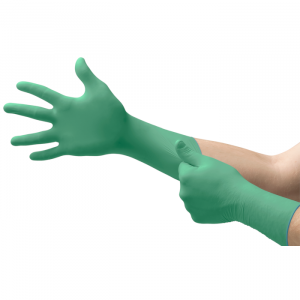
MICROFLEX® 93-260
299 kr excl. VAT -

AlphaTec® 58-335 (12-pack)
900 kr excl. VAT -
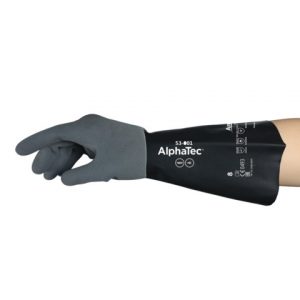
AlphaTec® 53-001
210 kr excl. VAT -

AlphaTec® 02-100
165 kr excl. VAT
Why use chemical protection gloves?
Our skin protects us against a lot, but it is sensitive to chemicals. Many chemicals can easily enter the body through the skin and cause chemical burns or poisoning. That is why it is important to protect your hands with chemical protection gloves against hazardous chemicals. With the right glove you are protected against serious injuries, but also against other problems such as allergies, itching and eczema.
Chemicals react in different ways with the material they come into contact with, so it is important to know the risks when choosing a glove. It is therefore important to know which chemicals the glove must protect against and whether there are other risks such as sharp edges or heat.
How long does the glove protect?
Protection against chemicals is limited in time. After a certain time the hazardous chemicals will permeate the glove. The breakthrough time depends on the type of material, the thickness of the material in the glove and the chemical in question. The process starts when the glove is exposed to contamination and is always counted from that moment, even if the glove is rinsed or washed. It is therefore not advisable to keep using the glove later on if more time has passed than the chemical protection chart shows.
Standards
Gloves are divided into 3 categories depending on type and the risk the gloves must protect against. The gloves in our range belong to Category 3 – gloves used in hazardous environments where there is a high risk of serious injury. They are approved according to standard EN 374, which specifies the requirements for gloves so that the user is protected against hazardous chemicals and micro-organisms.
Breakthrough times for permeation
| >10 | 10-30 | 30-60 | 60-120 | 120-240 | 240-480 | >480 |
| Not recommended | Splash protection | Splash protection | Medium protection | Medium protection | Good protection | Good protection |
The normalised breakthrough time for permeation is the time (in minutes) it takes for the chemical in question to permeate the material at a rate of 1.0 µg/cm2 /min (according to EN ISO 374) or 0.1 µg/cm2 /min (according to ASTM F739).
| Material | Nitrile | Nitrile / Neoprene | Nitrile | Nitrile / Neoprene | LLDPE | ||
| Thickness (mm) | 0,12 mm 4,7 mil | 0,19 mm 7,8 mil | N.A. | NA mm 15 mil | 0,062 mm 2,5 mil |
||
| CAS | Chemical name | % | |||||
| 1336-21-6 | Ammonia, solution in water | 25 | 29' C | 51' C | >480' C | 382'C | 27' C |
| 1310-73-2 | NaOH | 50 | >480' C | >480' | >480' | >480' | >480' C |
| 7664-38-2 | Phosphoric acid | 85 | >480' C | >480' C | >480' | >480' | >480' C |
| 7697-37-2 | Nitric acid | 70 | <5' C | 39' C | 30-60' | 240-480' | >480' |
| 7647-01-0 | HCl | 37 | 51' | >480' C | >480' | >480' C | >480' C |
| 7664-93-9 | Sulfuric acid | 50 | >480' C | >480' | >480' | >480' C | >480' |
The coloured cells with numbers and the symbol C correspond to experimentally determined data generated by an accredited laboratory. The remaining cells contain estimates.
We would like to stress that permeation times do not correspond to a safe time of use. The safe time of use can vary depending on whether the personal protective equipment has been put on correctly, the ambient temperature, the toxicity of the chemicals and other factors. The permeation information given here is limited to the main protective material. Permeation times may vary around seams, zips, visors or other joins or parts of the personal protective equipment. It is the responsibility of your organisation’s health and safety staff to carry out a risk assessment before choosing suitable personal protective equipment for the task. If you would like to discuss any aspect in detail, please contact us.
The estimates of the protective equipment’s barrier properties are based on currently available data and extrapolations from laboratory test results and information on the chemicals’
composition. Synergistic effects of mixing chemicals have not been taken into account. The estimates may change if new tests are carried out or if new information becomes available that provides a better basis for extrapolation. For these reasons all data in this report are provided for information purposes only, and Ansell disclaims all liability, including warranties, relating to any statements contained herein.